













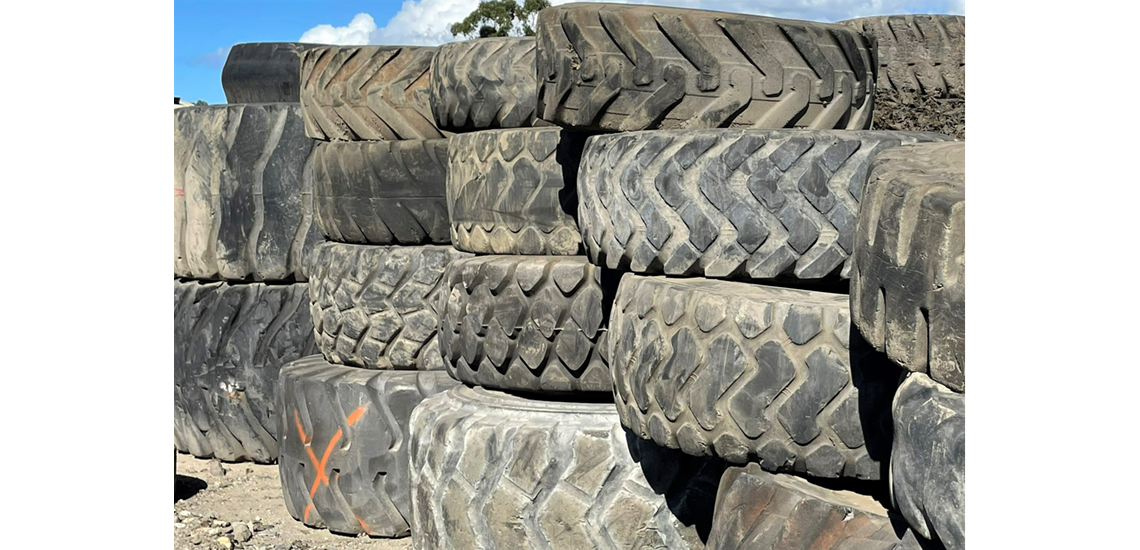
Rio Tinto and Tyre Stewardship Australia (TSA) are partnering to address one of the mining industry’s most complex waste challenges: recycling OTR tyres and conveyor belts from mining operations
A single haul truck tyre measures up to 2.5 metres in diameter and weighs around three tonnes, meaning it is built for extreme durability. Rio Tinto and TSA partnered up to explore practical ways to give end-of-life tyres and belts a second chance, rather than sending them to landfill. In Australia, around 245,000 tonnes of OTR tyres, conveyor belts and tracks reach the end of life, TSA estimates. However, only 10% are currently reused, recycled or repurposed.
Lina Goodman, CEO of TSA, said: “Rio Tinto is playing a crucial role in raising awareness, as well as bringing recyclers, global technology companies and local stakeholders to the table to develop practical and scalable solutions. These efforts will have other positive spin-offs too. New technologies and logistic pathways to service mining tyres will make the collection and recovery of agricultural and other tyres more feasible.”
“Combined with a potential for improved site rehabilitation and new workstreams, these projects may create many future opportunities for local communities,” she explained.
One major proof-of-concept was delivered at the Argyle diamond mine in Western Australia, which ceased production in 2020, after almost 40 years. After concluding extensive planning and technology assessment phases, in 2023, more than 800 tonnes of end-of-life OTR tyres and conveyor belts were transported from the remote site and processed by Carroll Engineering into rubber crumb for road construction usage.
“The project sets an example for contemporary mining, diverting valuable materials from landfill and demonstrating a commitment to a circular economy,” Mick, Carroll Engineering’s director and founder, said.
Rio Tinto is also happy with the results that this trial phase has had. “Our recycling trials have been very successful so far,” said Vikas, Procurement Business Partner at Rio Tinto. “But best of all, we’ve now taken the template from Argyle and replicated it at several other sites, continuing to improve as we go.”
Since the Argle trial, Rio Tinto has rolled out tyre recycling initiatives at Boyne Smelter, Yarwun and Weipa in Queensland, with a pilot conveyor belt recycling project underway at Gove in the Northern Territory. Another two proof-of-concept trials have also been completed at iron ore operations in the Pilbara, with the support of new recycling facilities.
David, Principal Spares and Disposals, Iron Ore, said: “As the technologies develop, we may be able to further reduce our reliance on virgin rubber products, so it’s less of a drawdown on natural resources. And in practical terms, it could reduce our requirements for extensive stockpiling areas throughout operations.”
Beena, Principal Advisor in the Rio Tinto Closure Excellence team, said the Argyle project has had a broader impact across the industry. “Argyle demonstrated how we can plan for and execute larger-scale and longer-term circular economy projects. If sites have more cost-effective and technology-enabled options to proactively manage their waste, we will be better positioned to deliver value for both the business and the environment.”