












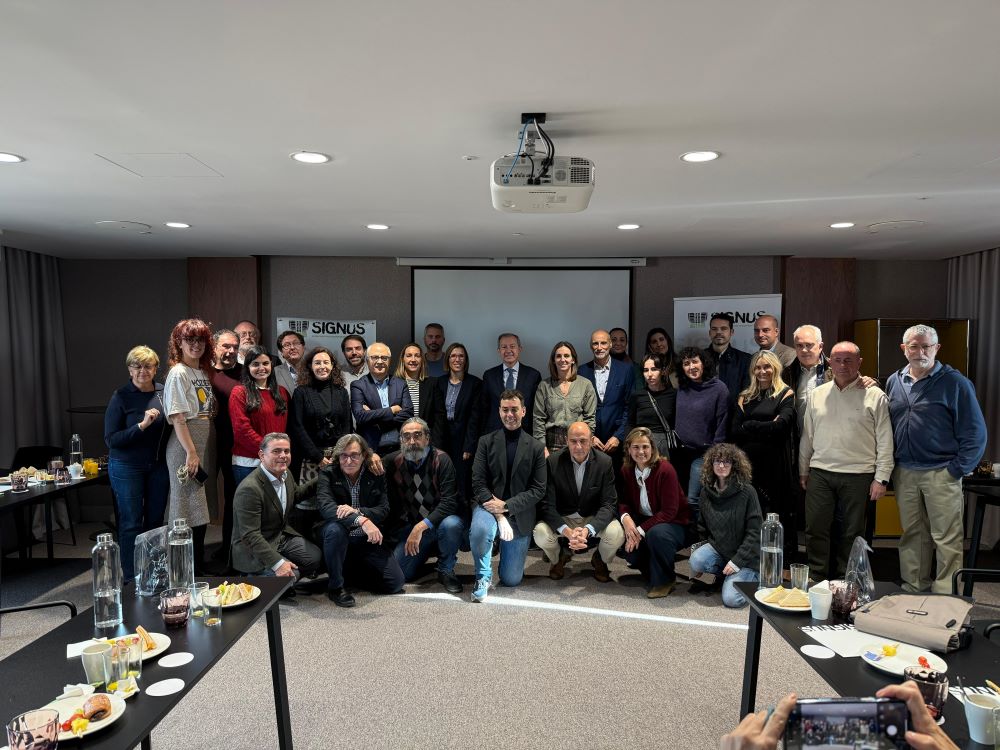
At its traditional breakfast with journalists in Madrid, SIGNUS shared its preliminary data for 2025, explained the impact of the new Royal Decree on ELT management, announced the updated Ecovalor fee to ensure the system’s sustainability, and announced that Bridgestone assumes the chairmanship of the SIGNUS Ecovalor Board of Directors
During the annual SIGNUS breakfast, topics discussed included the main management data for 2025, although not yet consolidated, the key developments of the new Royal Decree regulating the management of end-of-life tyres (ELTs), the challenges and projects for 2026, and the next year’s Ecovalor fees that will cover the management of ELTs. The organisation also announced the recent appointment of Daniel Camacho, Head of Region South West, Bridgestone Europe, as the chairman on behalf of his company.
SIGNUS also highlighted the main developments that will positively impact ELT management: administrative simplification through a single authorisation model for the whole national territory; eco-modulation in establishing management costs; greater involvement of producers in the system’s operation; promotion of prevention and recycling; and the setting of targets for the 2025–2035 period, particularly an increase in recycling and material recovery.
General Manager Carlos Prieto highlighted that the organisation is expected to manage around 220,000 tonnes in 2025, which is 6.1% above the System’s assigned responsibility, equivalent to approximately 10,000 extra tonnes. This excess collection is mainly due to imports and intra-community acquisitions that are not declared, as well as second-hand tyres placed on the replacement market by Authorised Treatment Centres (CATs). For this reason, SIGNUS is calling for stronger control and inspection by the competent authorities — something already included in the new Royal Decree.
The new regulation sets a gradual increase in recycling and material recovery, which would reach 65% by 2035. This involves higher management costs for end-of-life tyres, which, together with the gap between the tonnes that must be collected and managed and the declarations submitted by affiliated companies, have led SIGNUS to adjust the Ecovalor fee to ensure the system’s sustainability and the proper environmental management of ELTs, as required by the regulation.
Technical Department also presented its main projects in 2025, including the Guide on Circular Materials with Recycled Tyres in Construction, a technical tool for incorporating high-value recycled materials into building solutions, as well as the evaluation of pyrolysis technologies for both the rubber and textile fractions of ELTs. Another one is the GREENFU Project, focused on developing thermoplastic–rubber compounds with applications in sectors such as automotive and construction, and the PERSEUS Project, funded by the CDTI, which focuses on designing a safe, durable pavement that reduces traffic-related noise emissions.
In 2026, SIGNUS will focus its efforts on urban rubberised pavements and assessing the feasibility of manufacturing concrete using rubber made from ELTs.